Sales Call Review - How to Analyse Every Call and Close More Deals
There is a moment in almost every lost deal where the prospect decided.
Not when they said they were going to think about it. Not when they stopped replying to emails. Before that. A specific moment in the conversation where something shifted. Where the energy changed. Where the deal was still winnable and then, because of something said or not said, it was not.
Most reps never find that moment. They finish the call, feel a vague sense that it did not go as well as it could have, and move on to the next one. The same mistakes happen the next call. And the one after.
Sales call review is the process of finding that moment. Specifically. Not "I think the pricing conversation went a bit wrong" but "at 6:42, the prospect asked about implementation time and I talked for four minutes without asking a single question back. That is when they checked out."
That level of specificity is what separates reps who improve fast from reps who improve slowly.
Why Most Reps Skip Call Review
Ask any sales rep if they review their calls and most of them will say they do. Ask them when they last listened to a full recording and the answer is usually months ago, if ever.
The honest reason is time. Reviewing a forty-minute call takes forty minutes. Finding the relevant moments takes more time on top of that. For a rep carrying a full pipeline, an extra hour after every call is not realistic.
The second reason is that listening to yourself is uncomfortable. You hear the filler words. You hear yourself ramble. You hear the moment you got nervous and your energy dropped. Most people would rather not hear it.
Both reasons are understandable. Neither changes the outcome. The reps who do call review consistently close more deals. The reps who do not stay at roughly the same close rate for years, wondering why they keep losing deals to competitors.
What a Good Sales Call Review Actually Tells You
Most call review that does happen is too vague to be useful. A rep listens back, cringes at a few moments, and summarises it as "could have handled the pricing better." That does not change anything.
Good call review is forensic. It identifies three things precisely.
First: where the prospect's engagement changed. This is usually audible. The pace of their responses slows. Their answers get shorter. They stop asking questions. There is a specific moment where the call shifted from collaborative to transactional. Finding that moment tells you where you need to look.
Second: what caused the shift. Usually one of a small number of things. You talked too much. You moved to price before establishing value. You answered an objection by defending your product instead of exploring their concern. You missed a buying signal and let the momentum die. The cause is almost always findable once you know where to look.
Third: what to say instead. Not "be better at objection handling" but the specific alternative response that would have kept the conversation moving. This is the part that makes the review actionable. Without a specific alternative, the review is just self-criticism.
The Compound Effect of Reviewing Every Call
The reps who get dramatically better over ninety days are almost always the ones who have built a consistent feedback loop.
They finish a call. They find out what went wrong. They have a specific thing to do differently next time. They make the next call with that adjustment. They repeat this every day.
Most reps have a feedback loop that runs on a quarterly review schedule, or whenever their manager happens to have time. That means they are making the same mistakes for months before anyone catches them.
The difference between a daily feedback loop and a quarterly one is not subtle. After ninety days, the rep with daily feedback has made ninety adjustments. The rep without has made one. That shows up in the numbers.
What You Actually Find When You Review Enough Calls
Here is what consistent call review reveals over time that nothing else does.
Your patterns. Not the individual calls that went badly but the things you do on almost every call that work against you. The specific question you always skip in discovery. The moment you always rush to present the product. The way you always respond to a certain type of objection that does not work.
Patterns are invisible when you are in the middle of a call. They become obvious when you look at ten calls in a row. And patterns are what move close rates, because fixing one pattern affects every future call, not just the next one.
Your lost deals are not random. When you review enough calls you realise that most of your lost deals have something in common. A type of prospect you struggle to close. A stage in the conversation where things consistently fall apart. A competitor objection you consistently handle poorly. Finding this tells you exactly where to focus.
Your wins are more repeatable than you think. The calls that go well tend to have a structure. A question you asked early that set the right frame. A way of handling a certain concern that consistently builds trust. Identifying what you do on your best calls and doing more of it is as valuable as fixing what you do wrong.
How SalesGuard Does This Automatically
Manual call review - recording the call, listening back, finding the key moments, making notes - takes time most reps do not have.
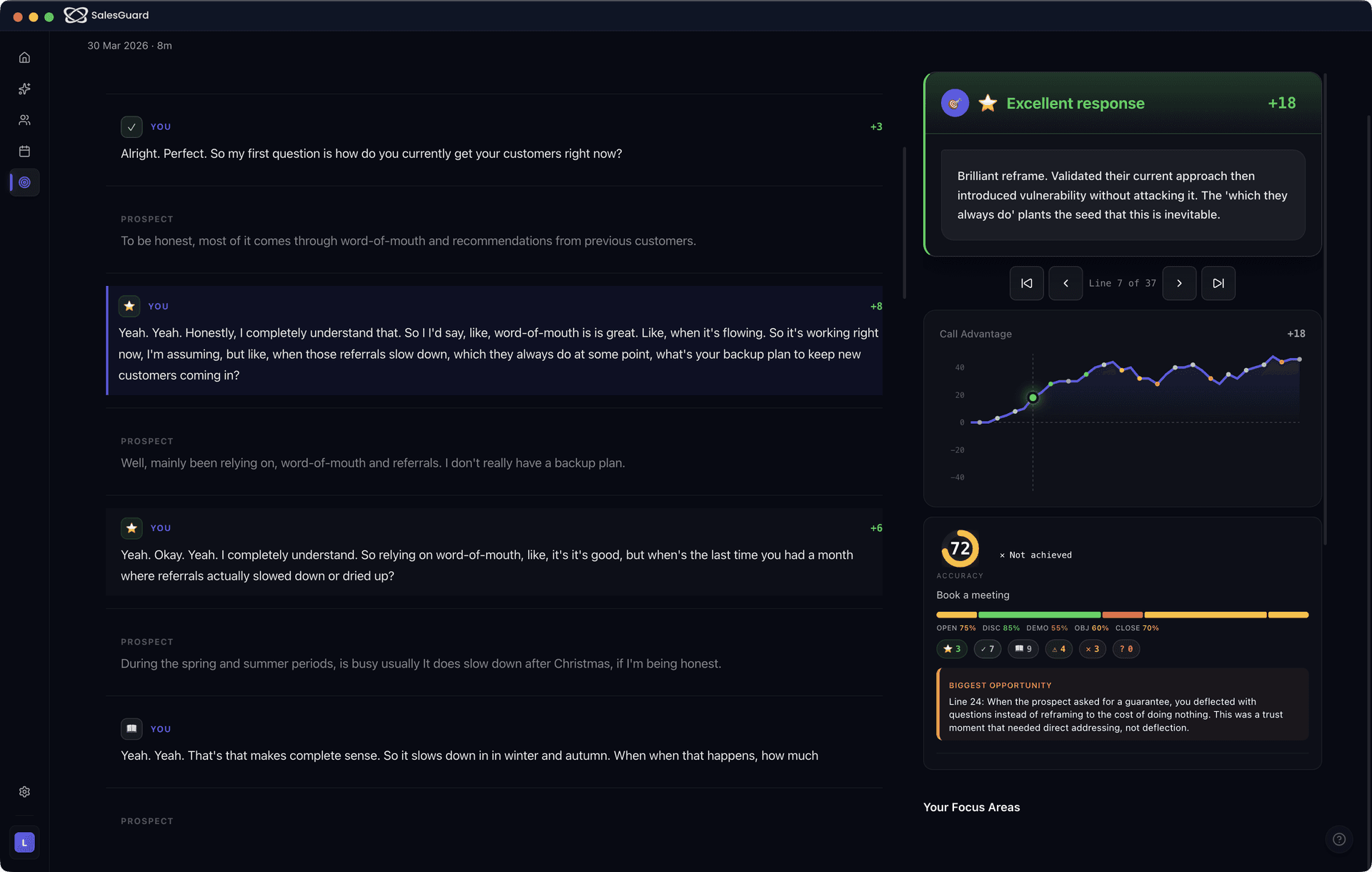
After any recorded call, you can generate a full post-call breakdown with one click. SalesGuard identifies the moments where prospect engagement shifted, the objections that came up and how they were handled, the buying signals that appeared, and the specific exchanges where the deal moved forward or stalled.
The breakdown is specific. Not "the pricing conversation could have gone better" but the exact timestamp, what was said, and what a stronger response would have looked like.
You get this after every call without spending an extra hour on it. The feedback loop that used to require a dedicated coach now happens automatically.
Pro plan includes 40 post-call reviews per month. Elite includes 100.
The Simple Version
You cannot fix what you cannot see.
Most reps lose deals they should have won and never find out why. They keep making the same mistakes for years because nobody ever showed them the exact moment things went wrong and what to say instead.
Sales call review fixes this. Not vague review. Specific, forensic, timestamped review that tells you exactly what happened and exactly what to do differently.
Do it consistently. Fix one thing per call. After ninety days, your close rate looks different. After a year, you are a materially better sales rep.
The reps who do this are not special. They just know what happened on their last ten calls. You should too.
Try It Free
SalesGuard includes automatic post-call review on Pro and Elite plans. Three-day free trial. No setup required.
Related: Real-Time Sales Coaching | Stop Filling In Your CRM Manually